
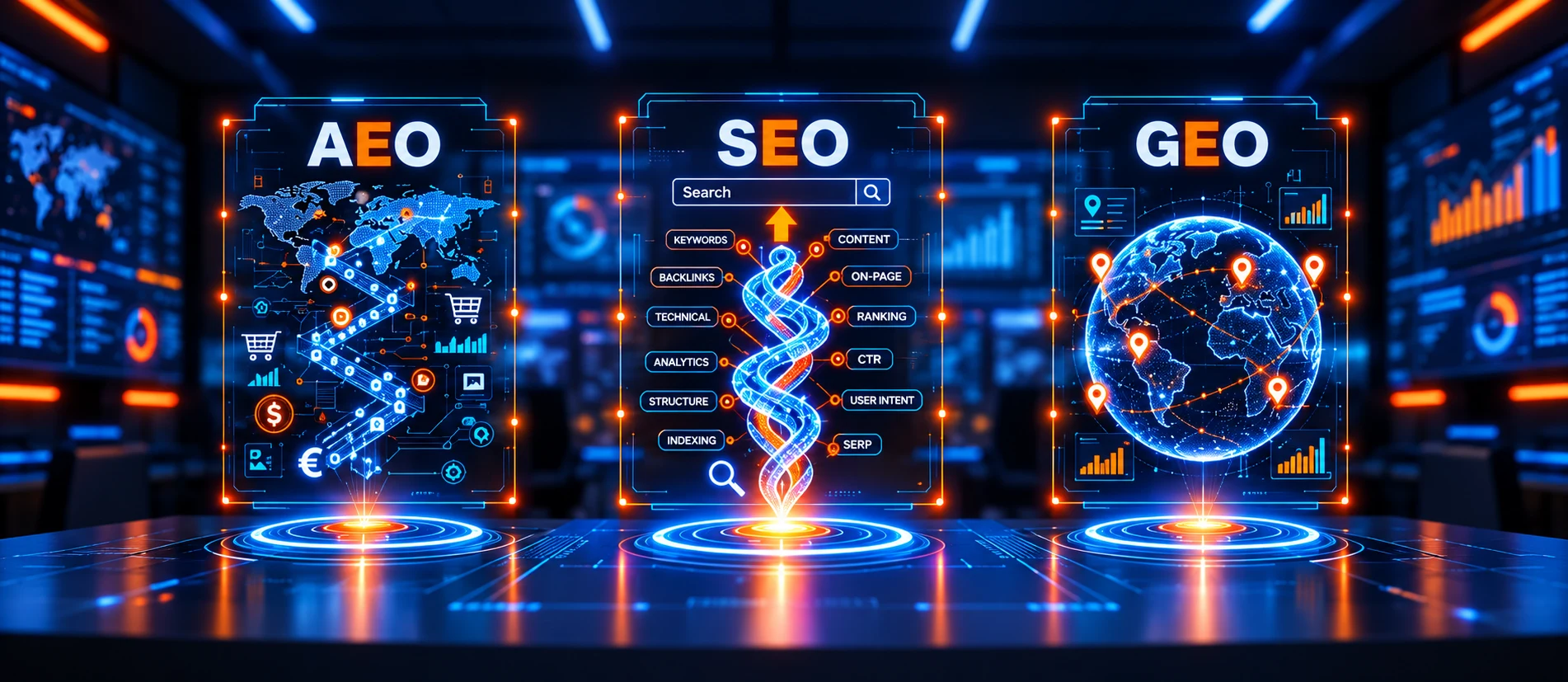
Search is changing rapidly in 2026. People no longer rely only on traditional Google search results to find information, compare services, or choose a business. They are also exploring AI-powered search experiences, including Google's AI Overviews, AI Mode, and conversational AI tools.
For businesses, this creates a major new opportunity: improve search engine rankings while making their expertise easier for AI-powered systems to discover, understand, and reference.
This is where SEO, AEO, and GEO come into the picture.
But what do these terms mean? How are they different? And which strategy should businesses follow to improve their online visibility in 2026?
In this comprehensive guide, we explain SEO vs AEO vs GEO, their key differences, and practical strategies businesses can use to strengthen their Google rankings and AI search visibility.
What Is SEO, AEO, and GEO?
SEO, AEO, and GEO are related approaches to improving online visibility. They focus on different aspects of how people discover information through search engines and AI-powered platforms.
1. What Is Search Engine Optimization (SEO)?
Search Engine Optimization (SEO) is the process of improving a website so that its pages can be discovered and ranked for relevant searches in search engines such as Google.
The primary goal of SEO is to help the right audience find your website when they search for products, services, or information related to your business.
For example, a business owner searching for a digital marketing company in Pune may see websites that Google considers relevant and useful for that query. A well-planned SEO strategy can help businesses improve their visibility for searches related to their services.
Key SEO activities include:
- Keyword research: Identifying relevant keywords that potential customers use when searching online.
- On-page SEO: Optimizing page titles, meta descriptions, headings, URLs, and content.
- Technical SEO: Improving crawlability, indexability, mobile usability, and website performance.
- Content optimization: Publishing useful, original content that addresses search intent.
- Internal linking: Connecting relevant pages to help users and search engines discover website content.
- Off-page SEO: Building credibility through relevant mentions, links, and other legitimate promotional activities.
2. What Is Answer Engine Optimization (AEO)?
Answer Engine Optimization (AEO) focuses on making website content easy to identify, understand, and use when search platforms provide direct answers to users' questions.
Instead of targeting only broad keywords, AEO places greater emphasis on answering specific questions clearly and accurately.
"What does a digital marketing agency do?"
"How much does website development cost in Pune?"
"How can a small business improve its Google rankings?"
"What is the difference between SEO and Google Ads?"
AEO-friendly content answers these questions directly and then provides enough context to help readers understand the subject thoroughly.
Important AEO practices include:
- Answering relevant questions near the beginning of each section.
- Using descriptive H2 and H3 headings.
- Creating useful FAQs based on actual customer questions.
- Explaining technical concepts in simple, accessible language.
- Including accurate facts, real examples, and supporting evidence.
- Using appropriate structured data when it accurately represents visible page content.
Note: AEO can support visibility in answer-oriented search experiences, including featured snippets and some AI-generated answers. However, no particular content format guarantees that a platform will select or display your answer.
3. What Is Generative Engine Optimization (GEO)?
Generative Engine Optimization (GEO) focuses on improving the chances that a brand's website, expertise, or published information will be discovered, understood, or referenced in responses generated by AI-powered search and conversational systems.
These systems may combine information from multiple sources to create an answer rather than presenting only a conventional list of links.
"Which digital marketing companies can help a small business improve its online visibility in Pune?"
The system may provide recommendations or summarize information from sources it considers relevant. Whether a particular business appears depends on the platform, query, available information, and its retrieval and selection processes.
Businesses can work toward stronger GEO visibility by:
- Publishing original, informative content with genuine industry depth.
- Clearly explaining their services, expertise, and target audience.
- Maintaining accurate business information across relevant platforms.
- Supporting important claims with trustworthy sources.
- Building a credible online presence through relevant industry mentions and references.
- Organizing content so that key information is easy to locate and understand.
- Reviewing how often their brand and website appear in relevant AI-generated responses.
GEO is an evolving area of digital marketing. It is important to distinguish established SEO practices from experimental techniques that do not yet have consistent evidence of improving visibility across AI platforms.
SEO vs AEO vs GEO: Key Differences
Although SEO, AEO, and GEO share a common goal of improving online discovery, their specific areas of emphasis differ:
| Comparison Metric | SEO (Search Engine) | AEO (Answer Engine) | GEO (Generative Engine) |
|---|---|---|---|
| Primary Focus | Search engine visibility | Answer visibility | AI-generated response visibility |
| Main Objective | Improve relevant organic rankings | Make content useful for direct answers | Improve discoverability and potential references in AI responses |
| Content Approach | Relevant, comprehensive, search-focused content | Clear, question-based answers | Clear, trustworthy, context-rich information |
| Important Activities | Technical SEO, keyword research, internal links, content optimization | Direct answers, useful FAQs, structured content | Original insights, brand credibility, clear facts, relevant third-party mentions |
| Possible Outcome | Organic search traffic & clicks | Answer-oriented visibility & snippets | Brand mentions, citations, referrals, or discovery through AI |
| Guaranteed Placement? | No | No | No |
The Important Takeaway
SEO, AEO, and GEO are not three completely separate marketing systems. They overlap heavily, and many of the same improvements can support all three. Google's official guidance explains that its AI search features continue to rely on established search and quality systems. It does not require a separate set of special technical optimizations just to become eligible for AI Overviews or AI Mode.
Why SEO, AEO, and GEO Matter in 2026
Search behavior continues to evolve, and businesses need to adapt their content strategies accordingly:
1. Customers Use Multiple Discovery Paths
Some people search using short phrases such as "SEO company in Pune." Others ask detailed questions, compare alternatives, or use conversational AI tools to explore options. Addressing these diverse intents broadens your customer reach.
2. AI Search Creates New Discovery Opportunities
AI-powered search experiences provide summaries and links to sources that help users investigate a topic further. A useful, well-structured website has more opportunities to appear as a supporting source.
3. Helpful Content Builds Commercial Trust
People seek reliable information before making purchasing decisions. Detailed service explanations, transparent pricing guidance, practical examples, and relevant case studies establish genuine credibility for professional services.
4. Local Search Visibility Still Dominates
For businesses serving specific areas like Pune, local SEO remains crucial. Maintaining accurate Google Business Profile information and creating content that serves local audiences drives foot traffic and qualified inquiries.
How to Improve Google Rankings and AI Search Visibility in 2026
Businesses do not need to abandon their existing SEO strategy to prepare for AI-powered search. Instead, they should strengthen their foundations and improve how they communicate useful information. Follow these 8 practical steps:
Identify the Right SEO Keywords
Start by understanding what your potential customers search for when looking for your products or services. For a digital marketing agency, relevant keyword themes might include:
- Digital marketing company in Pune
- SEO services in Pune
- Website development company in Pune
- AI search optimization services
- Google Business Profile optimization
- Lead generation services for small businesses
Use Google Keyword Planner, Google Search Console, and other reputable keyword research tools to evaluate search demand, competition, and existing website performance. Do not select keywords based on search volume alone; a keyword with modest search demand but strong commercial intent is often far more valuable than a broad query.
Create Content That Answers Real Questions
Search engines and AI systems need understandable, relevant information to help answer user queries. Create content around the questions your audience genuinely asks:
- How much does SEO cost for a small business?
- How long does SEO take to show results?
- Is SEO better than Google Ads?
- How can businesses improve their visibility on Google Maps?
- What should a business look for when choosing a website development company?
Answer the main question early in your content, then explain the reasoning, steps, limitations, and practical examples. Avoid publishing repetitive articles that simply target minor keyword variations.
Structure Your Content Clearly
Good content structure helps readers navigate a page and makes important information easier to identify for AI crawlers:
The goal is clarity and usefulness, not a rigid mathematical formula designed specifically for an AI engine.
Publish Original and Trustworthy Information
Original information gives readers and AI systems a compelling reason to visit and cite your website rather than relying on a generic summary. Strengthen articles with:
- Practical examples drawn from real client projects.
- Original observations, unique frameworks, or industry research.
- Genuine case studies with documented, accurate results.
- Expert commentary from qualified practitioners and team members.
- Visual diagrams, workflow charts, or demonstrations where relevant.
- Trustworthy sources and documentation supporting factual claims.
Never invent client metrics, statistics, or fake credentials. Clearly identifying authors and their relevant experience reinforces trust for both search engines and potential clients.
Strengthen Technical SEO
Even excellent content needs to be accessible to search engines. Regularly audit these technical foundations:
- Crawlability & Indexability: Ensure essential pages can be indexed without accidental noindex directives or crawl blocks.
- Mobile Usability: Verify seamless performance across smartphones, tablets, and varying screen viewports.
- Page Experience: Optimize loading speeds, core web vitals, navigation, and visual stability.
- Internal Linking: Establish contextual links connecting high-intent service pages to relevant educational articles.
- XML Sitemap: Maintain clean sitemaps containing canonical URLs.
- Canonical Tags: Eliminate duplicate content confusion across parameter URLs.
- Structured Data: Implement valid Schema.org markup (such as BlogPosting, Organization, and FAQPage) that matches visible page copy.
Google's documentation states that no special schema type is required specifically to appear in AI Overviews or AI Mode. Standard structured data still aids general comprehension.
Build Brand Credibility Beyond Your Website
Your website is your digital home, but customers and AI engines discover your brand through third-party platforms across the wider web:
- Maintain an up-to-date and verified Google Business Profile.
- Earn genuine customer reviews across Google, Clutch, and LinkedIn.
- Publish insightful thought leadership on social channels and partner blogs.
- Participate in relevant industry discussions and local business forums.
- Maintain consistent Name, Address, and Phone (NAP) citations across respected directories.
Avoid purchasing spam backlinks or fake review packets. Authentic brand prominence builds enduring credibility that AI search engines can corroborate.
Use FAQs Strategically
FAQs address friction points and make service pages significantly more useful for prospective clients. For example, a custom web design service page should clearly address turnaround timelines, pricing structures, responsive testing, and post-launch maintenance.
Each FAQ answer should be accurate, concise, and complete. Avoid adding FAQs simply to repeat keywords or assuming that FAQ schema guarantees a rich search snippet.
Measure SEO and AI Search Performance
Evaluate your organic and AI visibility with clear, measurable indicators rather than subjective assumptions:
| Measurement Metric | What It Helps You Understand |
|---|---|
| Organic Clicks | How much qualified traffic your website receives from organic search |
| Search Impressions | How often your pages appear in eligible Google search results |
| Keyword Positions | How your target landing pages perform for competitive commercial queries |
| Organic Conversions | How many calls, inquiries, or demo requests stem from search traffic |
| Referral Traffic | Whether identifiable AI engines or external websites refer active visitors |
| AI Brand Mentions | Whether your business is recommended in responses to relevant AI prompts |
| AI Citations & Links | Whether AI search systems cite your website as an authoritative reference |
| Lead Quality | Whether incoming inquiries convert into paying, sustainable business contracts |
Use Google Search Console and analytics tools for traffic insights. For AI visibility, track a consistent set of test queries across major platforms periodically.
Common SEO, AEO, and GEO Mistakes to Avoid
Businesses often make the mistake of treating AI search optimization as a quick shortcut to rankings. Avoid these common pitfalls:
1. Keyword Stuffing
Repeating keywords unnaturally makes copy painful to read and violates modern search quality guidelines.
2. Publishing Mass Generic AI-Generated Content
Content that merely repeats existing web summaries without unique insights fails to establish trust or ranking longevity.
3. Duplicate Location Pages
Local landing pages should provide genuine value for each specific area rather than swapping city names on identical text.
4. Adding Schema Without Purpose
Structured data must be strictly accurate, relevant, and consistent with the visible content on the webpage.
5. Expecting Guaranteed AI Citations
No agency can legitimately guarantee that a specific AI platform will mention, recommend, or cite a business.
6. Neglecting Technical SEO
Even brilliant copy cannot compensate for indexing blocks, broken links, or sluggish mobile loading times.
7. Focusing Only on Rankings Instead of Conversions
Traffic quality, lead inquiries, client conversion rates, and revenue impact matter far more than vanity rankings.
Which Strategy Should Your Business Choose: SEO, AEO, or GEO?
For the vast majority of businesses, the most effective approach is to combine all three rather than choose only one in isolation:
- Choose SEO as your foundation: Build organic search rankings, attract relevant organic traffic, and secure technical indexing stability.
- Include AEO practices: Satisfy users seeking immediate, direct answers to purchasing decisions and service comparisons.
- Develop GEO visibility: Improve brand discoverability, citations, and recognition within generative AI search models.
For example, a Pune-based business can target high-intent local keywords, publish comprehensive service pages, answer core customer questions, maintain accurate business directory profiles, and cultivate credible industry backlinks. These actions reinforce each other and produce an unshakeable digital footprint.
How WebJexa Can Help With SEO, AEO, and GEO
Improving online visibility in 2026 requires more than adding keywords to website content. Businesses need a coherent strategy that connects technical SEO, useful content, local search optimization, website performance, and measurable business objectives.
WebJexa Tech Solutions helps businesses build comprehensive search dominance through:
- SEO, AEO & GEO Services: Holistic search engine, answer engine, and generative AI optimization strategies.
- Website Design & Custom Development: Fast, modern websites built to convert search visitors into paying clients.
- Google Business Profile Optimization: Local Maps ranking optimization to capture high-intent geographic demand.
- Google Ads & PPC Advertising: Targeted campaigns delivering immediate lead flow.
- Lead Generation: Multi-channel customer acquisition pipelines.
- Social Media Marketing: Brand awareness and social engagement campaigns.
- E-commerce Development: Robust online shopping platforms tailored for growth.
Ready to improve your online visibility? Contact WebJexa today to discuss a digital strategy tailored to your business, audience, and growth objectives.
FAQs
Final Takeaway
SEO, AEO, and GEO work best when they are treated as connected parts of a broader search visibility strategy. Focus on making your website technically accessible, your content genuinely useful, and your brand information accurate and trustworthy.
These fundamentals provide a solid, sustainable foundation for Google rankings and discovery through AI-powered search in 2026.